
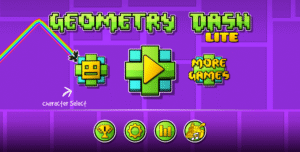


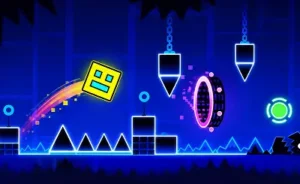
Geometry Dash Lite is not a casual browser game; it is a brutal, physics-based rhythm gauntlet that demands absolute perfection. With zero checkpoints in Normal Mode, a single mistimed input at 98% means you restart the entire track. This free, ad-supported port delivers 19 official levels of pure, unforgiving obstacle courses where your muscle memory and auditory synchronization are your only lifelines. Let’s try and play it now
Deconstructing the Geometric Physics
Every movement in Geometry Dash Lite is governed by a strict, deterministic physics engine. The auto-scrolling speed is locked, meaning your only variable is vertical momentum. When you tap the spacebar or click your mouse, the standard Cube initiates a fixed jump arc. There is no variable height, no ledge forgiveness, and no hesitation. You calculate the exact pixel of liftoff, or you shatter against a spike.
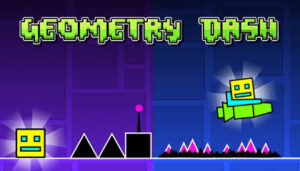
The mechanical complexity explodes when the game forces you through one of its 7 icon forms via gravity portals. Transitioning from the rigid jumps of the Cube to the fluid, momentum-heavy flight of the Ship requires an instant mental reset. The Wave form, introduced later, demands incredibly precise hold-and-release timing to navigate jagged corridors, punishing players who rely solely on visual cues rather than feeling the rhythm.
Because the obstacle layouts are intricately mapped to the pulsing electronic soundtrack, the game is fundamentally a test of audio-visual syncing. You aren’t just reacting to spikes rendering on screen; you are executing a sequence of inputs hardcoded to the tempo of the music.
How to Play Geometry Dash Lite?
Geometry Dash Lite features straightforward controls that are easy to learn, but mastering the game requires precise timing. On desktop, you can jump by pressing the Spacebar, Up Arrow key, or Left Mouse Button. On mobile devices, simply tap the screen. Although the controls are simple, timing each input to match the rhythm and beat of the level is crucial.
Basic Controls
| Action | PC | Mobile |
|---|---|---|
| Jump (Cube) | Spacebar / Up Arrow / Left Click | Tap the screen |
| Fly (Ship mode) | Hold Spacebar | Hold your tap |
| Wave mode | Hold to move up, release to move down | Hold/release tap |
| Pause | P key | Pause button |
| Restart level | Backspace | Restart button |
Advanced Progression and Survival Strategies
- Early Game Survival (The Fundamentals): Do not skip the early tracks. Stereo Madness and Back on Track are mandatory for establishing foundational jump timing and teaching you how to read the grid. Lock your eyes on the right-hand edge of the monitor to process incoming terrain early, rather than staring directly at your own icon.
- Mid-Game Resource Focus (Abuse Practice Mode): When you hit a wall in levels like Cycles or Clutterfunk, stop brute-forcing Normal Mode runs from 0%. Your mental stamina is a finite resource. Enter Practice Mode (Z key) and drop manual checkpoints at the specific 70% Ship transition that keeps killing you. Isolate the choke point, drill the muscle memory fifty times, and only return to Normal Mode when the movement becomes subconscious.
- End-Game Mastery (The Demon Threshold): By the time you reach Clubstep (Level 14) and Geometrical Dominator (Level 19), reaction time is completely obsolete. Surviving Demon-tier difficulty requires total rote memorization of multi-layered obstacle patterns and instant adaptation to rapid form switches. Ignore the hidden Secret Coins entirely on your first clear; risking your line for a collectible will only shatter your run.
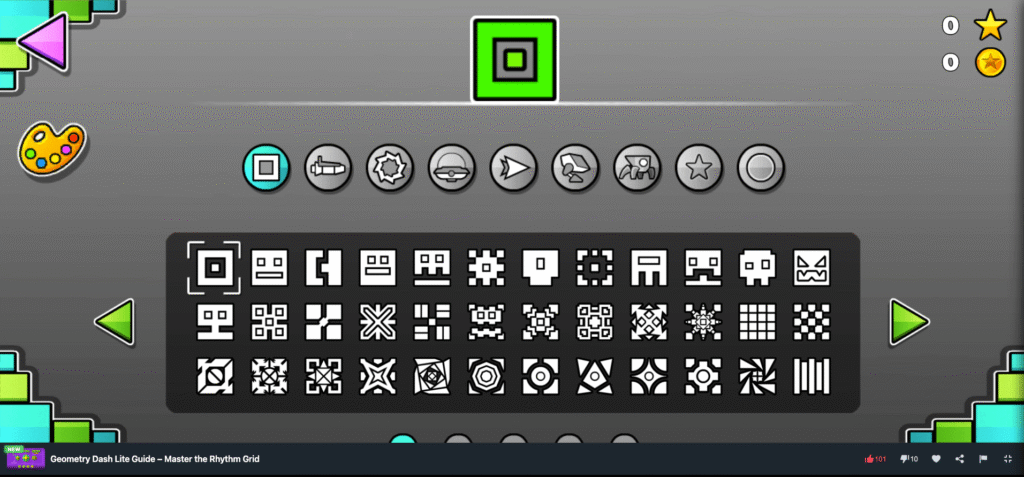
The Cycle of Absolute Perfection
The lack of loading screens between deaths turns this brutal gauntlet into an incredibly addictive psychological loop. Shattering your cube is agonizing, but the instant respawn constantly baits you into “just one more try.” Lock in your focus, sync your clicks to the bassline, and see if you have the discipline to clear Clubstep in a single, flawless run.



Leave a Reply