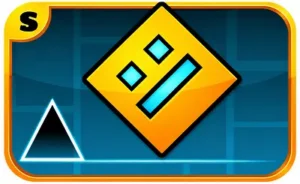



Playing Griffpatch’s Geometry Dash Scratch is a fascinating lesson in physics recreation and raw punishment. You are tackling three iconic levels—Stereo Madness, Back on Track, and Polargeist—rebuilt entirely within MIT’s block-coding engine. The difficulty curve hits incredibly fast. This isn’t a forgiving mobile port; it is a rigid, unrelenting test of input execution and rhythmic memorization that will ruthlessly expose sloppy timing. If you want to survive the grid, you need absolute mechanical discipline.
Deconstructing the Block-Engine Physics
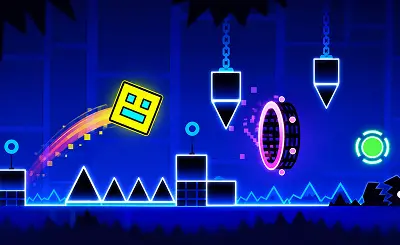
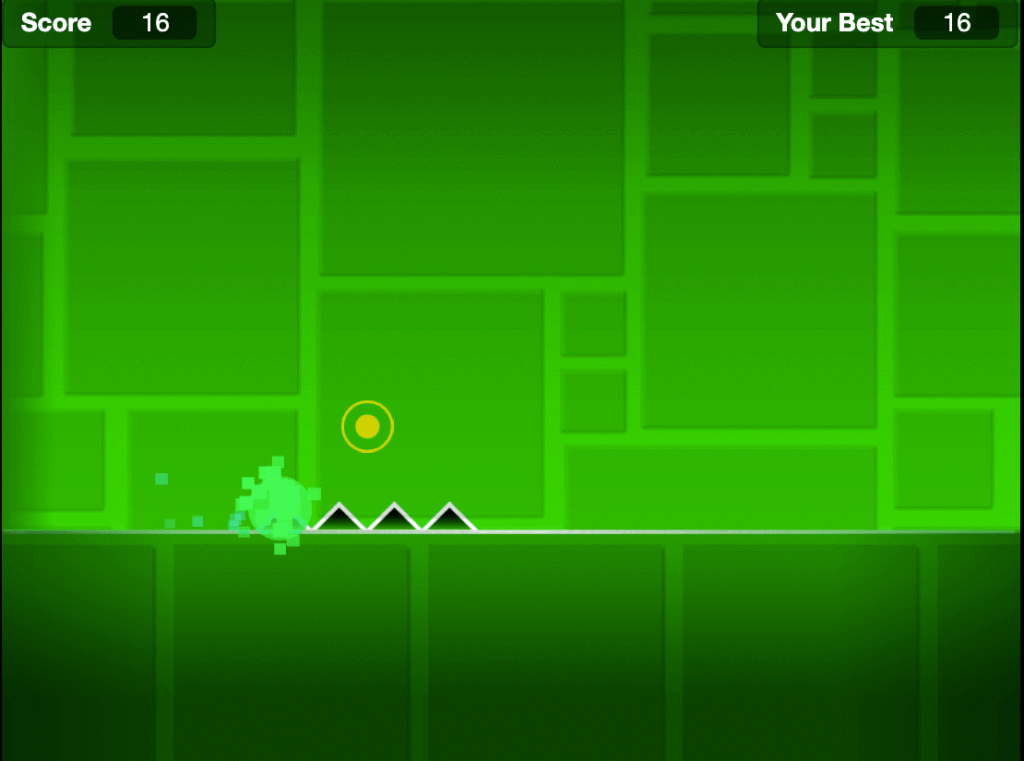
The underlying logic of this browser port is entirely deterministic, yet it carries the distinct mechanical flavor of the Scratch engine’s internal tick rate. Your avatar is locked into a constant forward velocity. You cannot brake, accelerate, or alter your trajectory mid-air. When you input a jump via the Spacebar or Left Click, the code locks your cube into a fixed, rigid mathematical arc. Because the collision physics are tied directly to the engine’s framing, your inputs must be absolutely precise. Late clicks are never forgiven by generous edge-detection hitboxes; if a single pixel overlaps with a spike, the run is completely dead.
The mechanical complexity shifts violently when you hit a vehicle portal and transition into Ship Mode. The logic completely rewires your brain from binary jump arcs to analog thrust management. Instead of tapping, you are now feathering the input to manage your altitude. Holding the button applies continuous upward thrust, fighting against the engine’s simulated gravity. The acceleration here feels heavy, meaning if you hold the input a fraction of a second too long, the ship will drift directly into the ceiling.
Mastering these transitions requires a strict phased approach to gameplay. You must treat the three available levels not just as stages, but as training modules. Phase One is fundamental execution in Stereo Madness, focusing entirely on binary jump arcs and establishing a baseline rhythm. Phase Two shifts to Back on Track, forcing you to tighten your timing window as the gaps narrow and the tempo spikes. Phase Three is the Polargeist exam, a brutal test of extended obstacle chains and advanced Ship control where rote memorization becomes mandatory. In this final phase, the entire two-minute layout must become hardwired into your hands, allowing you to navigate the hardest corridors on subconscious autopilot.
How to Play
Your cube moves forward by itself, so you only need to think about when to jump. The obstacles match the music, so listening to the rhythm is as important as reacting fast.
- On computer: Press the Spacebar or the Left Mouse Button to jump.
- Hold the button down: Your cube will jump again right after it lands. This is useful when there are many spikes close together.
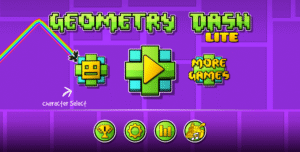
- Choose a level: Go to the main menu and pick Stereo Madness, Back on Track, or Polargeist.
If you touch a spike or hit a wall, the level starts again from the beginning. There are no checkpoints, so you must finish the whole level in one try without stopping. The more you learn the music’s beat, the easier it becomes to guess the next jump and avoid difficult obstacles.
Advanced Grid Execution and Resource Management
- Phase-Perfect Execution: Exploit the Input Buffer: When navigating tight clusters of consecutive spikes, do not attempt to manually time every single jump. The Scratch engine logic allows you to hold the jump button while airborne. This effectively queues up your next input, forcing the cube to launch on the exact frame it touches the ground. Use this buffering mechanic to clear dense trap setups with mathematical perfection rather than relying on raw, frantic reaction times.
- Stamina Control: Managing Mental Resources on Polargeist: Your primary resource in a one-button rhythm platformer isn’t health or mana; it is your raw focus. Polargeist represents a massive difficulty spike, introducing highly extended obstacle chains and claustrophobic Ship sections that demand intense micro-adjustments. Brute-forcing attempts while you are frustrated drains your mental stamina and ruins your rhythmic calibration. If you die ten times at the exact same gravity portal, stop immediately. Release the mouse, reset your posture, listen to the underlying bassline, and approach the choke point logically rather than emotionally. Stamina preservation is how speedrunners grind out perfect runs without burning out.
- Visual Discipline: Stop Tunnel-Visioning Your Cube: The absolute most lethal beginner habit is staring directly at the player icon. By the time an obstacle enters your direct line of sight in the center of the screen, your brain lacks the necessary milliseconds to process the visual data and execute the physical jump. You must force your eyes to track the extreme right-hand edge of the monitor. Reading the incoming geometry early allows your muscle memory to process the layout and queue up the correct physical response well before the hazard actually reaches your hitbox.
The Obsessive Pursuit of a Flawless Run
The lack of loading screens and the instant, frictionless restart loop turns every failure into pure competitive fuel. Wiping out at 95% on a brutal stage is agonizing, but jumping immediately back to the starting line is wildly intoxicating. I challenge you to load up Polargeist right now and clear the entire stage in under five attempts. Do you have the raw mechanical discipline to survive the grid?


Leave a Reply