

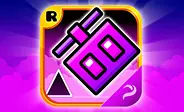




To conquer the 13 fixed-layout tracks of Geometry Arrow 2, you must completely surrender your conscious thought process to the rhythm. This isn’t just about fast reflexes; it is a profound test of cognitive flexibility. The grid demands that you seamlessly shift between two entirely different physics engines—flying and rolling—in the blink of an eye. Finding and maintaining your flow state is your absolute only survival tool. Come and play this game on our website to get fun and relax.
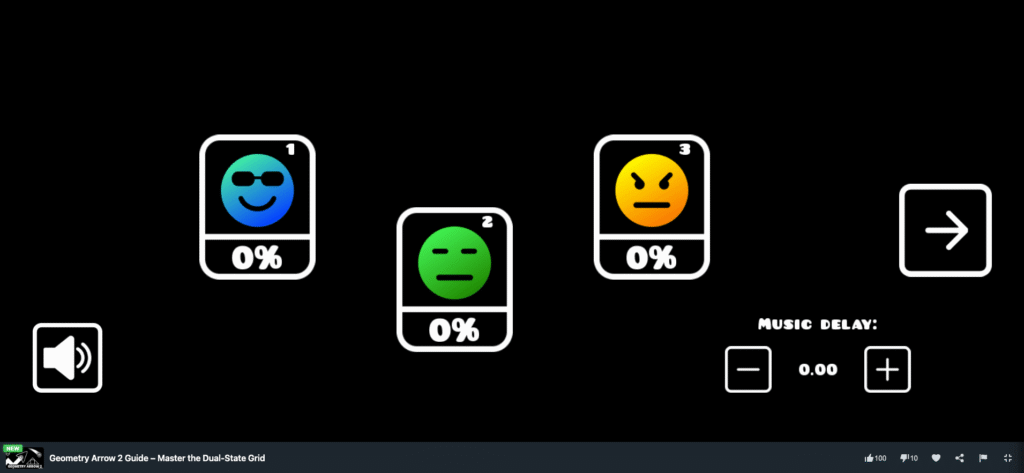
Deconstructing the Dual-Physics Engine
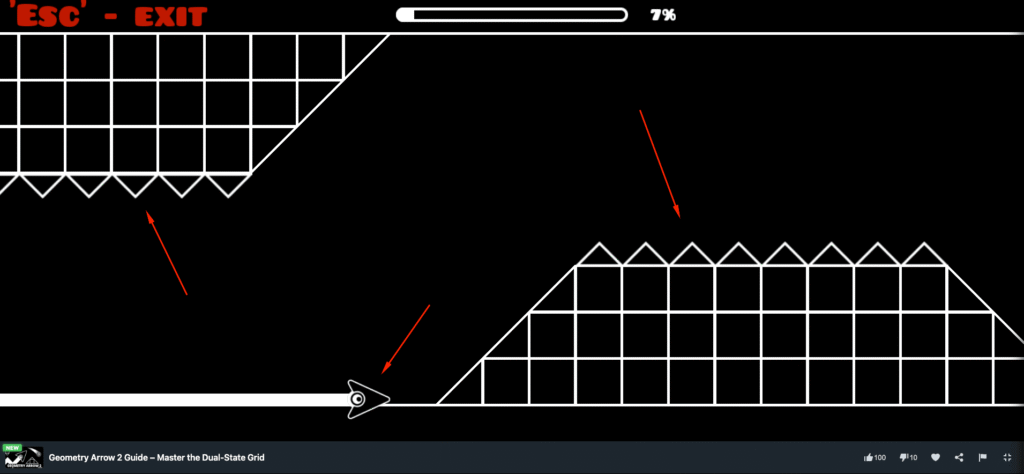
The Arrow state forces you into a rigid, continuous wave-style flight path. Because your forward velocity is completely locked by the relentless auto-scroller, you must manage your vertical oscillation through a strict binary input. Holding the button commands a steep, mathematical 45-degree climb, while releasing triggers an immediate, unyielding downward trajectory. There is no mid-air drift, no variable friction, and zero forgiveness. You must execute perfectly balanced, lightning-fast micro-holds to thread the needle through claustrophobic cave corridors without grazing the ceiling.
The exact moment you cross a transition boundary, the physics engine instantly grounds your avatar. The Wheel state shifts the mechanical demand from sustained vertical balancing to precise, percussive ground hopping. Here, digital gravity feels substantially heavier. A rapid tap executes a standard, low-arc jump to clear ground-level spikes, while striking the strategically placed blue jump bubbles launches your chassis into an extended, floaty aerial arc. Your hands must stop tracing smooth, continuous waveforms and instantly snap to a rigid, rhythmic beat.
The true cruelty—and the ultimate test of your mechanical skill—lies within the portal transitions themselves. Crossing a portal instantaneously overwrites the mechanical rules of your universe with zero transition frames. If you enter an Arrow portal still holding the input as if you were preparing to clear a spike cluster in Wheel mode, you will violently crash into the ceiling before your optical nerves even register the shape-shift. Surviving these bottlenecks demands absolute mental elasticity and the ability to wipe your muscle memory clean every few seconds.
Because the 13 levels utilize a fixed-layout architecture, there is absolutely no RNG (Random Number Generation) to blame for a failed run. The hitboxes never alter, and the cosmetic unlocks you earn through achievements—like new particle trails and wheel textures—do not change your physical momentum or gravity curve. You are building a mental library of physical motions, mapping the exact duration of every click to specific visual and auditory landmarks.
Advanced Grid Execution and Zen Tactics
- Phase One Tactical Anchoring (Master the Portal Shift): Stop staring directly at your avatar. To survive the later tracks where the grid speed violently escalates, you must anchor your vision to the right third of your monitor. When a portal enters your peripheral vision, mentally queue up the upcoming physics state. If a Wheel portal is rapidly approaching, align your Arrow’s flight path dead center so you hit the ground running with maximum neutral positioning, instantly ready to execute the first percussive jump. Use the early levels purely as calibration runs to synchronize your nervous system to the engine’s strict input latency.
- Phase Two Cognitive Pacing (Auditory Synchronization): As you push deeper into the gauntlet, your raw visual reaction time will naturally degrade. Your primary resource here is your mental bandwidth. Conserve it by trusting the electronic soundtrack completely. The obstacle layouts and sudden portal shifts are mathematically hardcoded to the snares and heavy downbeats. Let the music dictate your physical input cadence. When your hands operate on audio cues rather than visual panic, your conscious mind doesn’t burn out trying to process every individual spike.
- Phase Three Error Mitigation (The Blue Bubble Over-Commitment): Novice players often treat every single blue jump bubble as a mandatory launch pad. This is a fatal structural trap. While blue bubbles provide the necessary vertical thrust to clear massive chasms, hitting them at the wrong angle—or blindly tapping every bubble in a dense cluster—will completely shatter your landing rhythm, sending you directly into a hazard. Treat them as highly calculated utility nodes, not required checkpoints.
Screenshots game play Geometry Arrow 2 on MiniWebGames.com
Geometry Arrow 2 vs. Geometry Arrow
Geometry Arrow 2 builds on the original game by adding a second playable form, portal transitions, and customization based on achievements. Both games use the same wave-style controls and require precise gameplay, but the sequel offers more variety by mixing Arrow Mode and Wheel Mode within the same level. The original game only focuses on flying through cave obstacles with zigzag movement.
The sequel keeps this core mechanic but adds rolling sections, obstacle patterns that match the rhythm of the music, and achievements that unlock cosmetic customization. Players who want to learn wave control should start with the original, while those looking for faster transitions and mixed gameplay will find the sequel more challenging. Both games are free HTML5 browser games that run without any downloading or installing.
The Hypnotic Pull of the Grid
The instant, frictionless reset loop eliminates all downtime between failures, pulling you effortlessly into a deep, meditative gaming trance. Shattering at a late-stage portal transition is genuinely agonizing, but the flawless synchronization of music and mechanical movement guarantees that exact feeling of just one more try will keep you locked to the screen until the clear is finally secured.


Leave a Reply