



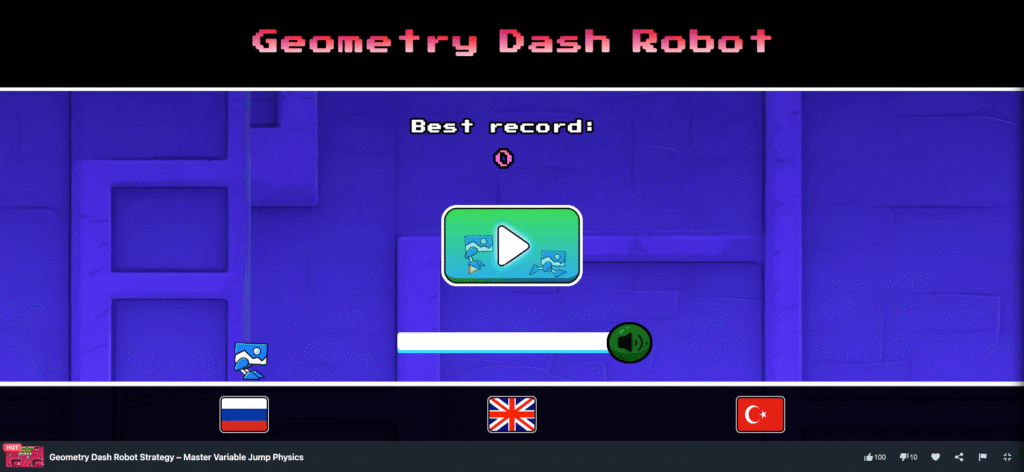
The Robot portal in Geometry Dash is where binary rhythm players usually meet a brutal reality check. Unlike the rigid, predictable arcs of the standard cube, the Robot introduces terrifyingly variable jump heights. Surviving this mechanical nightmare requires breaking your established muscle memory and learning to feather your inputs with absolute micro-precision to navigate a grid that actively punishes hesitation. Let’s come and play this game on our website.
Deconstructing the Variable Physics Engine
The underlying logic of the Robot form operates on a heavy, grounded physics model mixed with variable upward thrust. Your forward velocity remains strictly locked to the auto-scroller, but your verticality is entirely dependent on input duration. A lightning-fast micro-tap barely lifts the chassis off the ground, perfect for threading through tight spike corridors. Conversely, a sustained hold launches you into a massive, floaty arc. This fundamentally changes how you interact with the rhythm grid.
With the standard cube, your brain only calculates the exact pixel of liftoff. With the Robot, you must calculate both the liftoff and the exact millisecond of input release. If you hold the spacebar a fraction of a second too long, you will overshoot your designated landing platform and crash into a ceiling hazard. Furthermore, the Robot feels incredibly heavy when falling, but extremely light during the upward thrust. This jarring juxtaposition takes hours of isolated Practice Mode grinding to fully internalize.
The mechanical complexity violently spikes when transitioning from other portals. Moving from the rigid Cube directly into the Robot portal is where high-score runs die instantly. Your brain is naturally hardwired to hold the input to buffer consecutive jumps, but doing that with the Robot sends you flying blindly into the abyss. You have to actively suppress your conditioned reflexes the moment your character model shifts.
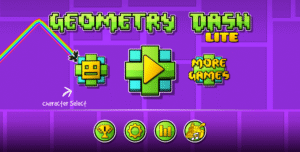
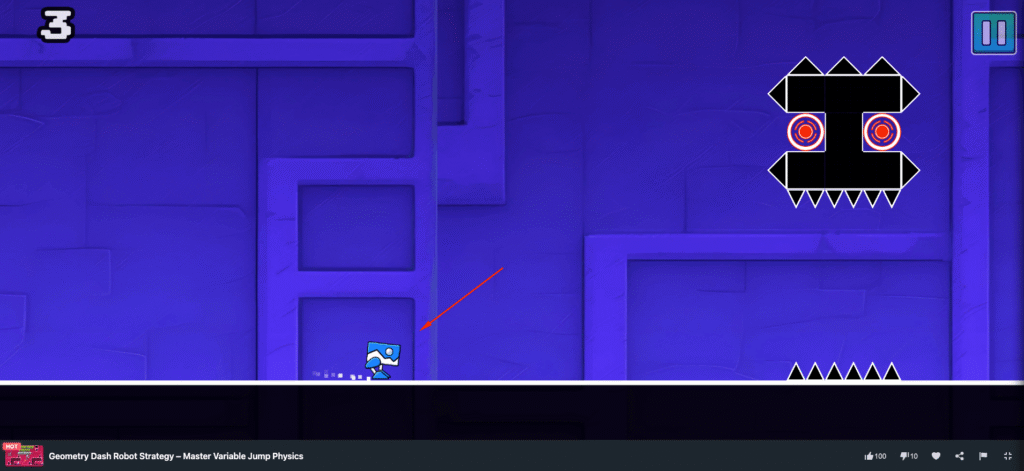
Screenshots game play Geometry Dash Robot on MiniWebGames.com
Advanced Grid Execution and Survival Phases
- Phase One: Calibrating the Micro-Tap (The First 60 Seconds): In the opening segments of a Robot track, your primary goal is completely resetting your muscle memory. Stop slamming the keyboard. Use the opening minute to practice the absolute minimum input required to clear a standard one-block spike. You must train your fingers to execute crisp, lightning-fast micro-taps, as over-jumping is the most common fatal trap for cube-conditioned veterans. Keep your momentum low and your trajectory flat.
- Phase Two: Orb Timing and Mid-Game Positioning: As the obstacle density escalates, you will encounter stepped platforms interwoven with jump orbs. Your mental stamina is your main resource here. Hitting a jump orb while in Robot form carries over the variable momentum rules, meaning early versus late orb taps completely alter your landing trajectory. Do not panic and hold the button out of fear. Focus strictly on your release timing. Landing dead-center on a platform dictates your survival for the subsequent jump, so carefully feather your inputs to maintain central positioning rather than hanging off the edges.
- Phase Three: Subconscious Audio Syncing (End-Game Mastery): When the speed peaks in Demon-tier sections, visual reaction time becomes completely obsolete. Staring directly at your Robot avatar will get you killed. Anchor your vision to the far right side of the monitor and let the electronic beat dictate your input duration. A heavy, sustained bass drop usually correlates to a max-height hold, while rapid snares demand precise micro-hops. Surrender to the audio cues, silence your internal monologue, and let your trained hands execute the sequence on pure autopilot.
The Dopamine Rush of Mechanical Perfection
Shattering into pieces because you held a jump one millisecond too long is agonizing, but the frictionless reset loop constantly pulls you right back into the grid. There is a deeply profound satisfaction that hits when your hands finally adapt, turning a brutal gauntlet of variable jumps into a flawless, synchronized masterpiece of pure muscle memory. Try yourself and beat this game 🙂









Leave a Reply