





Mastering the wave mechanic requires stripping away panic and finding absolute, unshakable focus. Geometry Arrow isolates the most notorious, run-ending mechanic from the Geometry Dash universe into a pure, unyielding gauntlet. You pilot a single zigzagging arrow through six progressively brutal cave corridors. Surviving this highly concentrated obstacle course isn’t about frantic, reactive clicking; it is a strict test of profound patience, internal rhythm, and unwavering muscle memory. Comes and play to relax with this game.
Deconstructing the Wave Physics
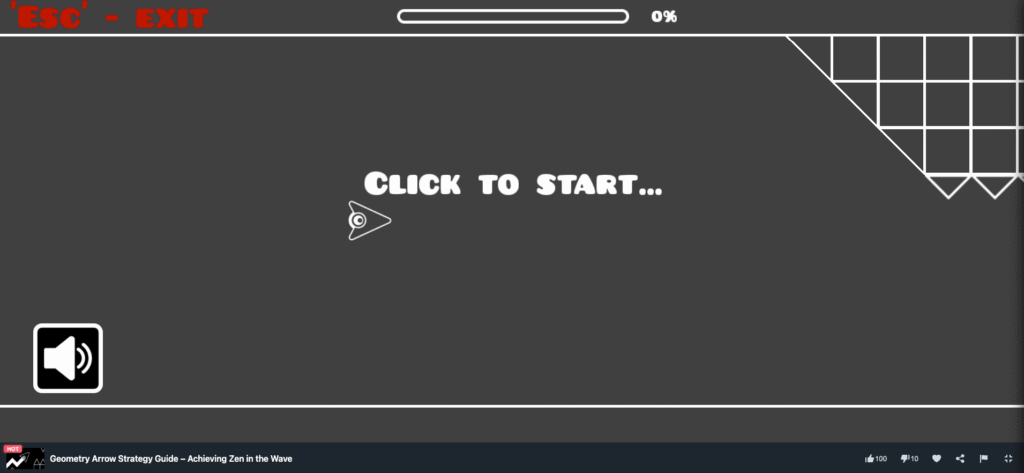
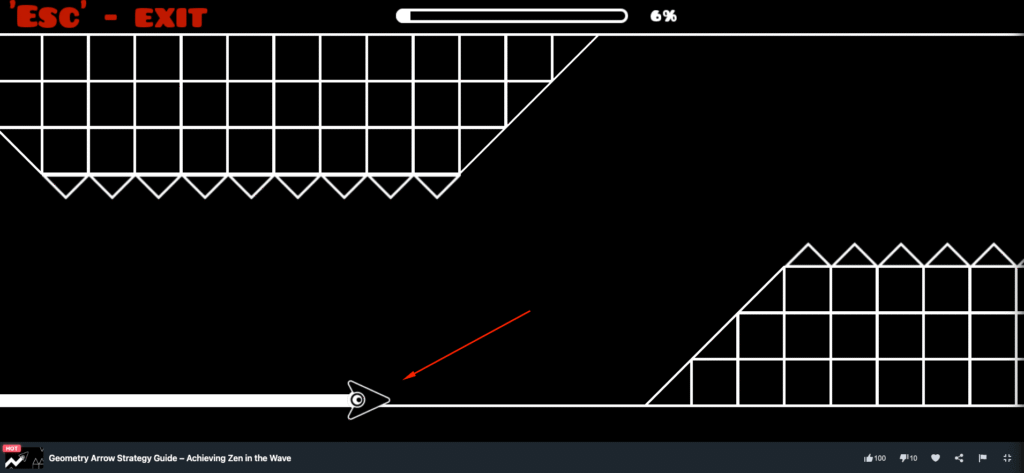
The physics engine governing your arrow operates on strict, binary logic, creating a continuous and unalterable zigzag trajectory. Because the auto-scroller dictates a relentless forward momentum, you possess absolutely zero control over your pacing. Vertical oscillation is your only method of survival. Holding the mouse button or spacebar completely defies gravity, angling your arrow sharply upward, while releasing the input initiates an immediate, steep downward dive. The angle of the ascent and descent never changes; only the duration of your input dictates how far you travel in either direction. This rigidity means that maintaining a straight horizontal line requires an incredibly rapid, perfectly balanced flutter-click technique.
Collision detection in this environment is absolute and entirely unforgiving. Grazing a single spike, scraping a ceiling, or clipping the floor instantly shatters your arrow, forcing a frictionless restart from zero percent. Interestingly, unlike traditional rhythm platformers, this specific spin-off does not force strict musical synchronization. You are navigating a purely spatial puzzle based entirely on fixed level layouts. Because the hazards remain completely static across every single attempt, you must develop your own internal metronome to conquer the grid.
Since the layouts never shift, rote memorization slowly transforms into subconscious physical execution. The jagged corridors and densely packed spike traps are deliberately designed to induce panic, baiting players into erratic, heavy-handed over-corrections. Success requires finding a state of flow, where your inputs smoothly transition from conscious, stressed visual reactions to deeply ingrained, relaxed muscle memory.
Phased Tactics for Wave Mastery
- Establishing the Baseline Tempo (The First 60 Seconds): Treat Level 1 and the opening sections of any new stage as your physiological calibration window. The structural gaps are significantly wider and the scrolling speed is forgiving, so use this exact time to establish a smooth clicking tempo. The most common early-game error is erratic, heavy-handed clicking that builds too much vertical momentum. Instead of long, sweeping holds that cause the arrow to drift wildly out of control, train your index finger to execute rapid, controlled micro-taps. Keeping your arrow tightly centered in the early corridors builds the exact physical discipline and grip stability required to survive the microscopic margins you will face later on.
- Visual Anchoring and Stamina (Mid-Game Focus): As you push into the medium and hard difficulties of Levels 3 and 4, the obstacle density spikes violently, and tunnel vision becomes your greatest enemy. Staring directly at your arrow severely limits your reaction time. You must actively anchor your vision to the far right-hand edge of the screen, processing the upcoming geometric patterns before they arrive. Furthermore, treat your mental stamina as a finite resource. The fail-retry loop is incredibly fast, making it easy to fall into a state of auto-piloting failures. If you find yourself tensing your forearm and shattering at the exact same spike cluster ten times in a row, step away. Forcing attempts through sheer frustration destroys your established muscle memory and hardwires sloppy execution into your hands.
- Subconscious Execution (End-Game Mastery): The final push through the expert-level corridors of Levels 5 and 6 introduces a terrifying speed escalation, typically right as you cross the 80% mark on the progress bar. This is where adrenaline causes your heart rate to spike, which traditionally ruins runs. When the speed shifts, conscious thought is far too slow; you must surrender entirely to your muscle memory. Anticipate the speed transitions rather than reacting to them. Maintain a loose, deeply relaxed grip on your mouse, silence your internal monologue, and let your trained hands execute the micro-adjustments on absolute autopilot to cross the final green portal.
Tips to Master Geometry Arrow
To get better at Geometry Arrow, you need control, good timing, and the ability to remember patterns. Here are some tips to help you play better:
Learn the Pattern, Not Just the Obstacles
Every level has the same design every time. Try to remember the order of the obstacles instead of just reacting when you see them.
Use Short Taps for Small Movements
Learn how to use quick clicks and long holds. Use short, quick clicks for small movements in narrow spaces, and hold the button for longer when you need to go up higher.
Watch the Progress Bar
Look at the progress bar to see how much of the level you have finished. Be careful after 80%, because the game often gets faster there, and many players fail near the green portal.
Focus on One Gap at a Time
Don’t think about the whole level at once. Break it into small parts. This helps you focus better and make fewer mistakes in difficult sections.
Take Short Breaks Between Tries
Don’t play too many times in a row without stopping. Short breaks help your reflexes, help you make fewer mistakes, and help you play better overall.
Some screenshots playing this game on MiniWebGames.com
The Infinite Loop of Refinement
The instant, frictionless restart loop turns every crushing failure into a pure, necessary learning experience. Shattering at 95% is genuinely agonizing, but do not let tilt ruin your session or drive you to rage-quit. Take a deep breath, trust your developing reflexes, and embrace the grind until that flawless, high-speed wave run feels completely effortless. Let’s try this excited game with us.







Leave a Reply