
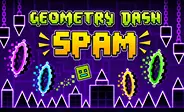
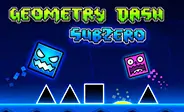

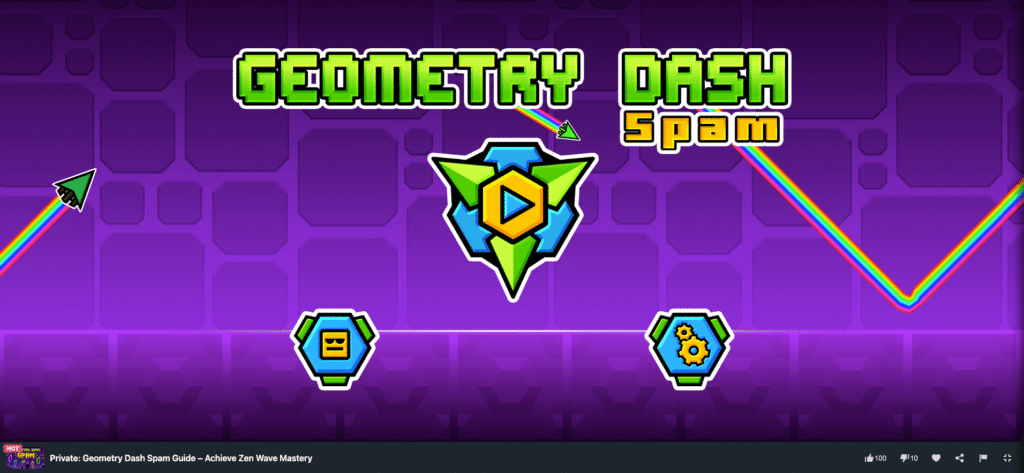
If you have ever shattered your icon two hundred consecutive times in a claustrophobic wave corridor, you understand the sheer mental tax of this mechanic. Geometry Dash Spam distills that exact frustration into a pure, isolated training ground. There are no lengthy level layouts to memorize—just you, an infinite spiked tunnel, and the relentless pursuit of rhythmic perfection. This game need try many times and relax your brain.
Deconstructing the Wave Physics and Flow State
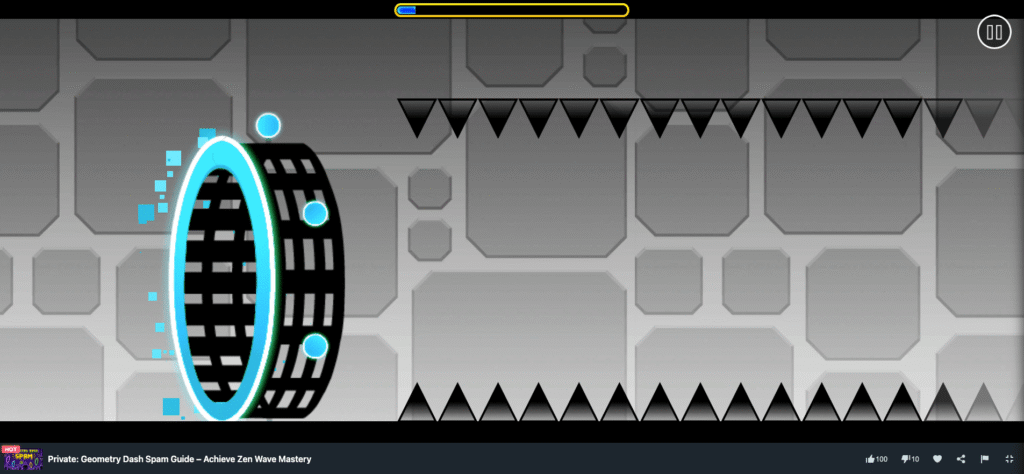
The physics of the wave are strictly binary, offering a brutal lesson in cause and effect. Click or hold your mouse to angle your trajectory upward; release the input to plummet downward. Every single action instantly reverses your vertical momentum, carving a sharp, continuous zigzag through the void. Because the game forces a constant, unyielding forward scroll, you possess absolutely no control over your pacing. Your survival is dictated entirely by the microscopic precision of your vertical transitions. Achieving a state of zen here means accepting that you cannot force the wave; you must simply guide it along the path of least resistance.
A massive misconception is that this simulator solely tests raw twitch speed. It actually tests your internal metronome. The collision detection is utterly unforgiving, meaning a fraction of a millisecond of hesitation clips the bottom spikes, while an over-held click slams you violently into the ceiling. The true challenge is maintaining a continuous, oscillating frequency without breaking form. You aren’t just clicking; you are vibrating at the exact frequency demanded by the shifting corridor.
This training ground also subtly prepares your muscle memory for other extreme mechanics in the main game. While wave sections require a perfectly balanced up-and-down zigzag, UFO sections test your ability to stack small hops without floating out of bounds, and ship sections demand delicate feathering to maintain level flight under intense pressure. By isolating the input rhythm here, you strip away the visual noise of a full level and train your nervous system to execute under pure, unadulterated stress. When you finally return to the standard game, those notoriously impossible wave corridors will suddenly feel slow, readable, and entirely within your control because your baseline processing speed has permanently increased.
How to Play this game
The controls are very simple. There is only one action, and it controls everything:
- Click or hold your mouse to make the wave go up
- Let go to make it come down
- You can also use the spacebar if you prefer the keyboard
- On mobile, just tap the screen
Every time you click, your direction changes. That’s the whole game, and that’s also what makes it difficult. There are three ways to die, and you will experience all of them quickly. If you stop clicking, you fall. If you click too slowly, you hit a spike. If you click too fast, you hit the ceiling. The tunnel gets narrower as you go, so you need better timing to survive.
Advanced Grid Execution and Survival Tactics
- Anchor Your Vision to the Horizon: The most fatal beginner mistake is visually tracking your own wave icon. By the time your brain processes a visual threat at the center of the screen, your physical reaction is already mathematically too late. Shift your focal point to the far right edge of the monitor. Let your peripheral vision handle the immediate airspace while your active focus reads the upcoming tunnel shifts, buying your brain the crucial micro-seconds needed to smoothly adjust your clicking frequency before the gap arrives.
- Manage Finger Stamina and Tension: Physical tension is the ultimate enemy of consistency. When the tunnel narrows, players naturally clench their mouse or keyboard, leading to rapid muscle fatigue and erratic, uneven inputs. Treat your forearm stamina as a finite resource. Play in sharp, highly focused ten-minute bursts and consciously relax your grip. If you feel a burn setting in or your rhythm starts to stutter, step away immediately. Pushing through fatigue only hardwires sloppy execution into your muscle memory. Try both the mouse and the spacebar to see which peripheral offers you the least physical resistance.
- Stop Panic Clicking (The Illusion of Speed): Frantic, uneven button-mashing will kill your run significantly faster than a slow, deliberate pace ever could. Many players mistake chaotic twitching for high-level execution, but uneven clicks create a jagged, unpredictable flight path that inevitably clips a hitbox. Instead of chasing maximum clicks per second, find a baseline rhythm you can hold comfortably without breaking a sweat, and slowly scale up the BPM. A smooth, even tempo will naturally guide you through tight corridors that panicked spamming will never survive. The wave draws a geometric zigzag; if the upward line is longer than the downward line, you drift off center. Consistency always beats raw velocity.
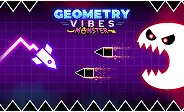
Screenshot Geometry Dash Spam on MiniWebGames.com
The Loop of Unconscious Execution
The frictionless, instant reset loop of this simulator is perfectly designed to strip away frustration and keep you anchored in the zone. Every crash is simply raw data for your nervous system to process. Breathe, relax your physical grip, and let the rhythm take over until you can thread the needle completely on autopilot. Let’s try and have fun 🙂


Leave a Reply