








Transitioning from a flat 2D plane to a fully rendered 3D space completely shatters everything you know about rhythm platformers. 3Dash takes the punishing mechanics of the classic formula and actively weaponizes the camera against you. It is no longer just about timing your inputs to a beat; it is a brutal test of spatial awareness and resource management where depth perception and optical illusions dictate your survival. Go and try this 3D Geometry Dash game will make you excited.
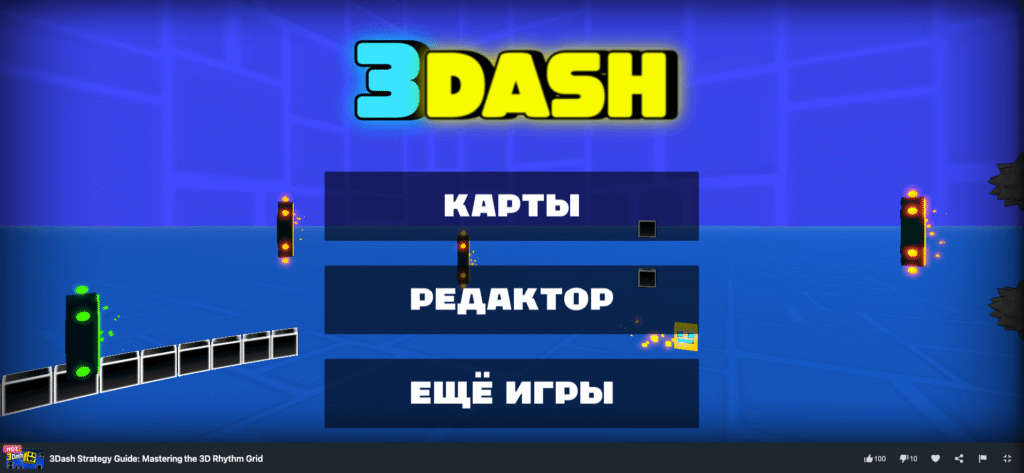
Deconstructing the 3D Physics Engine
The underlying logic of 3Dash operates on a ruthless, deterministic physics engine, but it layers a highly complex parallax effect over every obstacle. In standard flat games, your icon moves at a locked speed relative to a static screen. Here, the dynamic 3D camera accelerates, pans, and rotates independently of your avatar’s forward momentum. This creates a terrifying optical distortion: obstacles may appear to approach faster or slower depending on the camera’s current yaw and pitch. When you input a jump via the Spacebar or Left Click, the mathematical arc is identical to traditional games, but your depth perception is actively being manipulated by the shifting horizon.
The mechanical complexity violently spikes when interacting with gravity and speed portals. Transitioning from a standard cube into the Wave form completely rewires your spatial logic. You must hold and release to maneuver, but because the camera frequently banks at aggressive 45-degree angles, your visual horizon tilts. You are no longer navigating a straight 2D tunnel; you are threading a needle through a rotating 3D cylinder. This requires extreme spatial intelligence, forcing you to calculate the intersection of your geometric hitbox with polygons that are actively shifting perspective.
To master this engine, you must treat your cognitive focus as a strictly managed resource. Relying entirely on visual reflexes will drain your mental stamina within thirty seconds. You have to phase your learning approach: Phase One is mapping the audio cues to the physical layout, intentionally ignoring the camera tricks. Phase Two is utilizing Practice Mode to isolate the exact camera rotations that induce sensory overload, drilling those specific choke points until your muscle memory overrides your visual confusion.
Why 3Dash Feels Different From Geometry Dash
3Dash has the same rhythm gameplay as Geometry Dash, but the 3D camera changes how the levels feel. In normal GD levels, you look at the game from the side. You mainly watch the spikes and decide when to jump. In this game, you also need to think about depth, how the camera turns, and how far away the obstacles are.
Wave sections, gravity portals, speed changes, and tight jumps are harder to predict because the camera moves with the level. You cannot depend only on muscle memory anymore. Many experienced Geometry Dash players need more tries to improve their reaction timing and their sense of space in fast 3D sections.
Advanced Grid Execution and Spatial Management
- The Ultimate Beginner Trap – Trusting Visual Proximity: The sweeping camera deliberately skews your depth perception. If you wait until a spike looks physically close before tapping, the perspective shift will guarantee a late input. Do not trust your eyes to judge distance. You must anchor your actions to the audio track. The electronic beat is an unchangeable, rigid grid. Treat your eyes as a secondary source of information and your ears as the primary trigger for physical execution.
- Managing Cognitive Load During Extreme Camera Sweeps: 3Dash throws intense neon visuals and sudden perspective shifts at you to force sensory overload. When the track speeds up and the camera drops to a low-angle chase view, your brain will naturally panic. To counter this rapid drain on your focus, stop tracking your geometric icon. Lock your gaze firmly on the vanishing point at the center of the horizon. By letting your peripheral vision handle the immediate hazards, you drastically reduce the processing power required to interpret the 3D space, preserving your mental stamina for high-APM wave corridors.
- Input Economy – Aggressive Taps vs. Defensive Feathering: You must treat your physical inputs like a finite resource. Play aggressively during standard cube sequences—committing to firm, decisive clicks the exact millisecond the beat drops to maintain raw momentum. However, the instant you transition into a Ship or Wave portal, you must immediately shift to a hyper-defensive, low-input strategy. Because of the camera sway, every click in a 3D vehicle section alters your trajectory on multiple axes. Over-steering is a guaranteed death sentence. Feather your inputs with microscopic taps, using the absolute minimum amount of movement required to clear the hitbox boundaries.
Screenshots playing 3D Dash on MiniWebGames.com
The Dopamine Hit of 3D Perfection
The punishment for failing to read the 3D space is severe, but the resulting psychological payoff is unmatched in the rhythm genre. There is a deeply profound satisfaction that hits when you finally crack the spatial logic of a notoriously difficult custom map. When the camera spins wildly, the bass drops, and your hands execute a complex wave sequence purely on subconscious muscle memory, the game transcends simple platforming. It becomes a synchronized masterpiece of logic and reflex, guaranteeing that no matter how many times you crash, you will smash the restart button immediately.






Leave a Reply