




Geometry Portal Challenge completely rewires the traditional rhythm platformer formula by ruthlessly stripping away your ability to memorize the map. Dropped into a brutal, winter-themed obstacle course, every single death triggers a full procedural layout reset. You cannot brute-force this by memorizing spike placements. Surviving this unpredictable gauntlet requires intense mechanical adaptability, flawless input discipline, and the mental endurance to logically process new terrain at terminal velocity.
Deconstructing the Randomized Physics Engine
The underlying logic of this platformer operates on an uncompromising auto-scroll constraint. Your forward momentum is permanently locked, leaving verticality and airborne duration as your only controllable variables. Pressing the spacebar or clicking the mouse initiates a jump, roll, or glide depending on the immediate geometric context. There is no mid-air course correction and no variable friction on the icy platforms. Once you commit to an input, the physics engine locks your trajectory, forcing you to calculate liftoff pixels with mathematical precision before you even leave the ground.
The true mechanical twist that separates this from other browser-based dash games is the rogue-lite map generation. In standard platformers, rote muscle memory carries you through static choke points. Here, the procedural generation engine randomizes the icy platforms, spinning saw blades, and trap sequences every single time your character shatters. You are forced to shift from static memorization to dynamic pattern recognition. Your brain must logically group obstacle clusters on the fly, interpreting structural combinations in milliseconds rather than relying on a predetermined mental script.
This constant randomization severely taxes your cognitive resources. You aren’t just battling the jumping physics; you are actively managing your visual processing bandwidth. Transitioning rapidly between clearing a sudden spike pit and gliding under a suspended saw blade requires a strict, phased approach to screen tracking. You must maintain a steady, disciplined input rhythm while your eyes constantly scan ahead, building a temporary, disposable muscle memory that gets wiped clean the exact moment you crash.
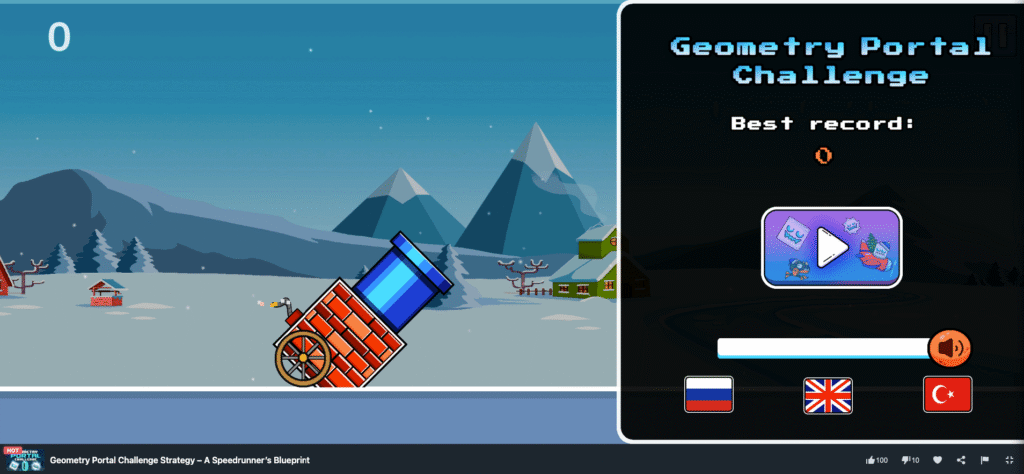
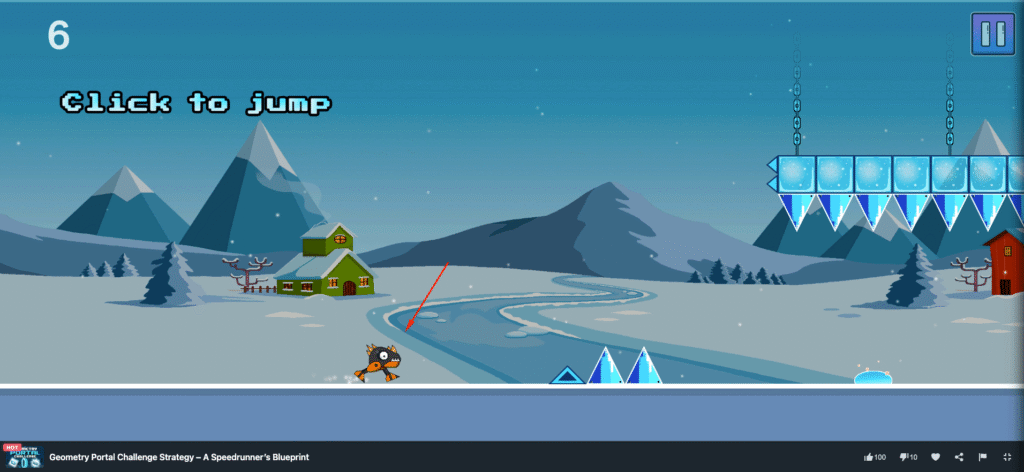
Some screenshots playing Geometry Portal Challenge on MiniWebGames.com
Advanced Grid Execution and Cognitive Resource Management
- The Ultimate Beginner Trap to Avoid (Visual Tunneling): The absolute most lethal beginner mistake is staring directly at your procedurally swapped character model. By the time a randomized saw blade enters the center of your screen, your reaction window has already permanently closed. You must physically anchor your gaze to the far right-hand edge of your monitor. Reading the incoming terrain early preserves your cognitive processing power, allowing your brain to logically parse the random trap sequences and queue up the correct physical response before the hazard actually reaches your geometric hitbox.
- Managing Mental Bandwidth During Intense Sequences: When the procedural engine generates three brutal obstacle clusters back-to-back, your natural instinct is to tense your forearm and hold your breath. This spikes your heart rate and completely destroys your fine motor control. Treat your mental focus as a finite, depletable e-sports resource. When a layout feels structurally overwhelming, consciously relax your mouse grip and rely on rapid micro-taps. If a sudden, unfair map reset causes you to tilt, pause the game immediately. Brute-forcing randomized maps while frustrated leads to sloppy input execution and instantaneous deaths.
- Balancing Aggressive vs. Defensive Input Economy: Because the track layout constantly shifts, you must constantly manage your input economy. Play aggressively during flat, predictable icy stretches to establish a strong rhythmic baseline, but immediately switch to a defensive, reactionary stance when the vertical terrain heavily fluctuates. In a defensive posture, keep your inputs as light and brief as mathematically possible. Over-committing to a long, sweeping glide when you do not know what lies just beyond the edge of the screen is a guaranteed run-killer.
Key Features
Winter-Themed Adventure – Explore a snowy world full of icy platforms, sharp spikes, and dangerous traps. The clean white graphics give every run a fresh, frosty look.
Random Maps – No two runs feel exactly the same. Each time you fail, the game creates a new map, so every attempt stays exciting and unpredictable.
Character Changes – After every crash, you come back as a different character. This adds variety to the gameplay and makes each run feel unique.
Endless Challenge – There are no fixed levels to finish. Keep playing, improve your timing, and see how far you can get without hitting an obstacle.
Simple One-Click Controls – Click the mouse, press the Spacebar, or tap the screen to jump, roll, or glide. The controls are easy to learn, but it takes practice to master the game.
The Infinite Loop of Adaptation
The instant procedural reset creates a vicious, highly addictive cycle of rapid adaptation. Shattering on a random spike right before the portal is agonizing, but the promise of a fresh layout instantly baits you back in. I challenge you to clear three consecutive randomized portals without dropping a single run. Do you have the raw adaptability to survive the frost?





Leave a Reply