
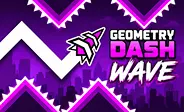


Geometry Dash Wave mode strips away every safety net standard rhythm platformers rely on, thrusting you into a relentless, high-velocity diagonal gauntlet. There are no flat surfaces to catch your fall, no variable momentum cushions, and zero room for error. Surviving this neon-soaked test of reflexes requires absolute mechanical discipline, elite spatial awareness, and a deep, intuitive understanding of binary physics. This is one of the most difficult game on the world and you should try to play and have fun.
Deconstructing the Binary Physics and Diagonal Mechanics
The underlying engine governing the wave form operates on a strict, unyielding binary switch. Your forward momentum is completely locked by an auto-scroller, stripping away any horizontal speed control. Your sole input variable is vertical oscillation. Depressing your mouse button, spacebar, or touch screen commands your icon to climb at a rigid, hardcoded 45-degree angle. Releasing that input instantly reverses your vector, forcing a steep, unyielding 45-degree dive toward the floor.
This mechanics profile creates a unique gameplay loop defined by the total absence of neutral ground. Unlike the standard cube or ship modes, you cannot coast, pause, or rest. Every single millisecond requires an active input decision. Navigating tight corridors demands an advanced mastery of input duration, transforming every map into a continuous stream of micro-adjustments. When you face rapid environmental shifts, your hands must instantly adapt to alternating upward and downward inputs without a single frame of lag.
Furthermore, the inclusion of speed portals violently alters the environmental pacing. When a portal shifts your velocity upward, your spatial processing window is compressed exponentially. A narrow corridor that was manageable at standard speed becomes a lethal bottleneck under high-velocity acceleration. Your brain cannot rely on visual reaction time alone at these speeds; optical latency is simply too slow for elite-tier challenges. You must build an internal metronome that maps your physical inputs directly to the environmental layout, letting your nervous system run on pure autopilot.
Advanced Survival Strategies and Phase-Based Execution
- Phase One: Perfecting the Micro-Tap Protocol: The most fatal beginner mistake is treating wave inputs like binary button mashing. Holding the key down creates massive, sweeping trajectories that inevitably clip ceiling spikes or floor hazards. To survive narrowing paths, you must master the flutter-click technique. Execute lightning-fast, shallow pulses that keep your zigzag amplitude as narrow as mathematically possible. This minimizes your vertical displacement and grants you immediate recovery options when unexpected obstacles materialize in tight spaces.
- Phase Two: Surgical Practice Mode Optimization: Do not waste mental bandwidth brute-forcing an entire level from the start when you hit a specific choke point. Utilize Practice Mode’s checkpoint system to isolate the exact frame-draining obstacle sequence that keeps ending your run. Drop a checkpoint right before the hazard and drill that specific 5-second window repeatedly until your nervous system automates the movement. Training your muscle memory in isolation transforms an impossible barrier into a predictable, routine execution.
- Phase Three: Auditory Synchronization and Risk Routing: High-tier wave mastery is fundamentally an auditory discipline. In well-designed wave stages, obstacles and gravity shifts are meticulously synchronized to the downbeats of the electronic soundtrack. Let your ears act as your primary warning system, queuing up your jump inputs a fraction of a second before your eyes register the hazard. Additionally, practice strict resource discipline regarding collectible coins. During initial progression runs, bypass any coin path positioned dangerously close to spike walls. Secure your clean completion line first; return for high-risk collectibles only after consistency is locked.
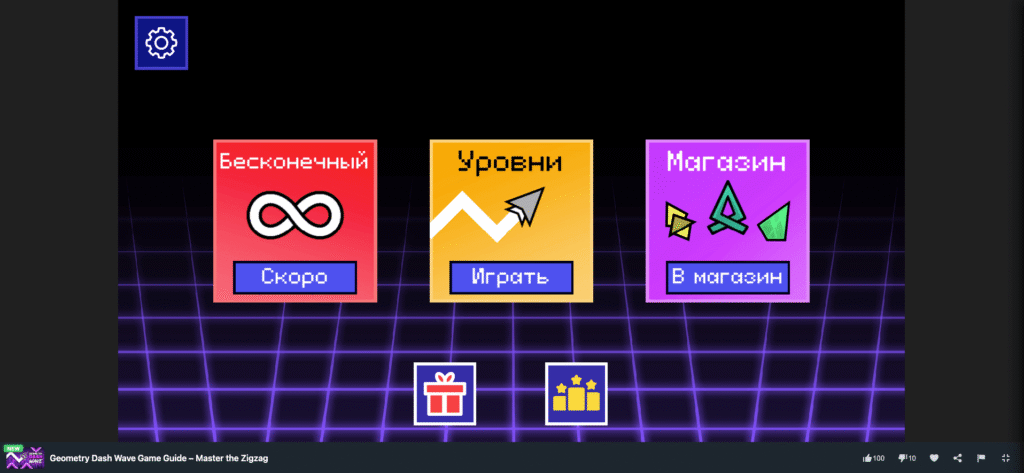
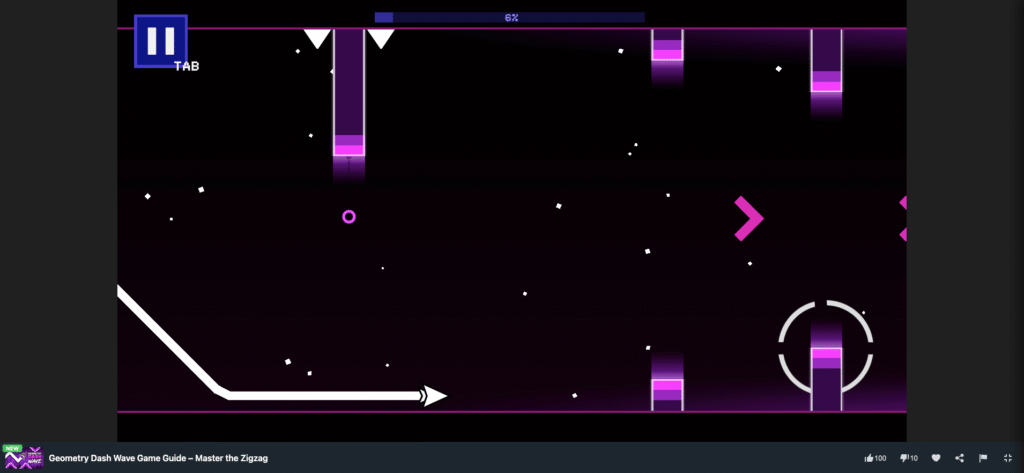
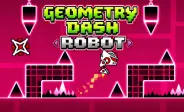
Screenshots Geometry Dash Wave game play on MiniWebGames.com
GD Wave Levels and Features
Geo Dash Wave has 6 levels, and each one has a difficulty rating. This means you always know how hard a level will be before you start playing it. The first levels teach you the rhythm. The later levels need real skill. Here are the best features:
- The Shop: Use the diamonds and coins you get from levels to unlock new arrow designs, trail effects, and colors. Your arrow doesn’t have to stay plain white forever.
- Practice mode: Place checkpoints during a run and practice the exact part that keeps making you lose.
- Rhythm-synced music: The obstacles appear on the beat of the music. So the music is not just for decoration — it also warns you what is coming.
Other good features are the neon graphics, moving dangers, and fast restarts. You crash, you come back, and you try again — there are no loading screens between one try and the next.
Why the Wave Grinds Your Focus into Pure Addiction
The psychological grip of the wave mode stems from its seamless, zero-latency restart loop. When a miscalculated micro-tap ends your run at 98%, the frustration is instantly swallowed by the absolute lack of loading screens. You are hurled back to the start line in a fraction of a second. That frictionless feedback loop eliminates downtime, keeping your competitive adrenaline fully saturated. Combined with the profound, tactile satisfaction of finally orchestrating a flawless, high-speed zigzag through a chaotic boss level or nailing an extreme difficulty stretch, it triggers an unmatched competitive dopamine rush. Every single crash acts as a diagnostic puzzle piece, training your subconscious patience until the entire map becomes a polished rhythm performance you are driven to repeat. Let’s come and play this game on our site and get your feeling 🙂



Leave a Reply